
Cast bronze thrust washers – metric sizes and to drawing
Flat rings of cast bearing bronze that carry axial load between a shaft collar and a housing or gear face. Machined from cast bronze plate, ring or tube in C93200 / SAE 660 as standard, C86300 and aluminium bronze for shock thrust, LG2 for water. Metric proposal series Ø12 – 200 mm shaft, any size to Ø1000 mm to drawing, plain face or with radial grooves. Greased solid bronze – not sintered, not PTFE-lined.
- Ø12 – 200mm shaft in the series
- 2 – 12mm thickness
- Ø1000mm to drawing
- 0 / −0.1mm thickness tolerance
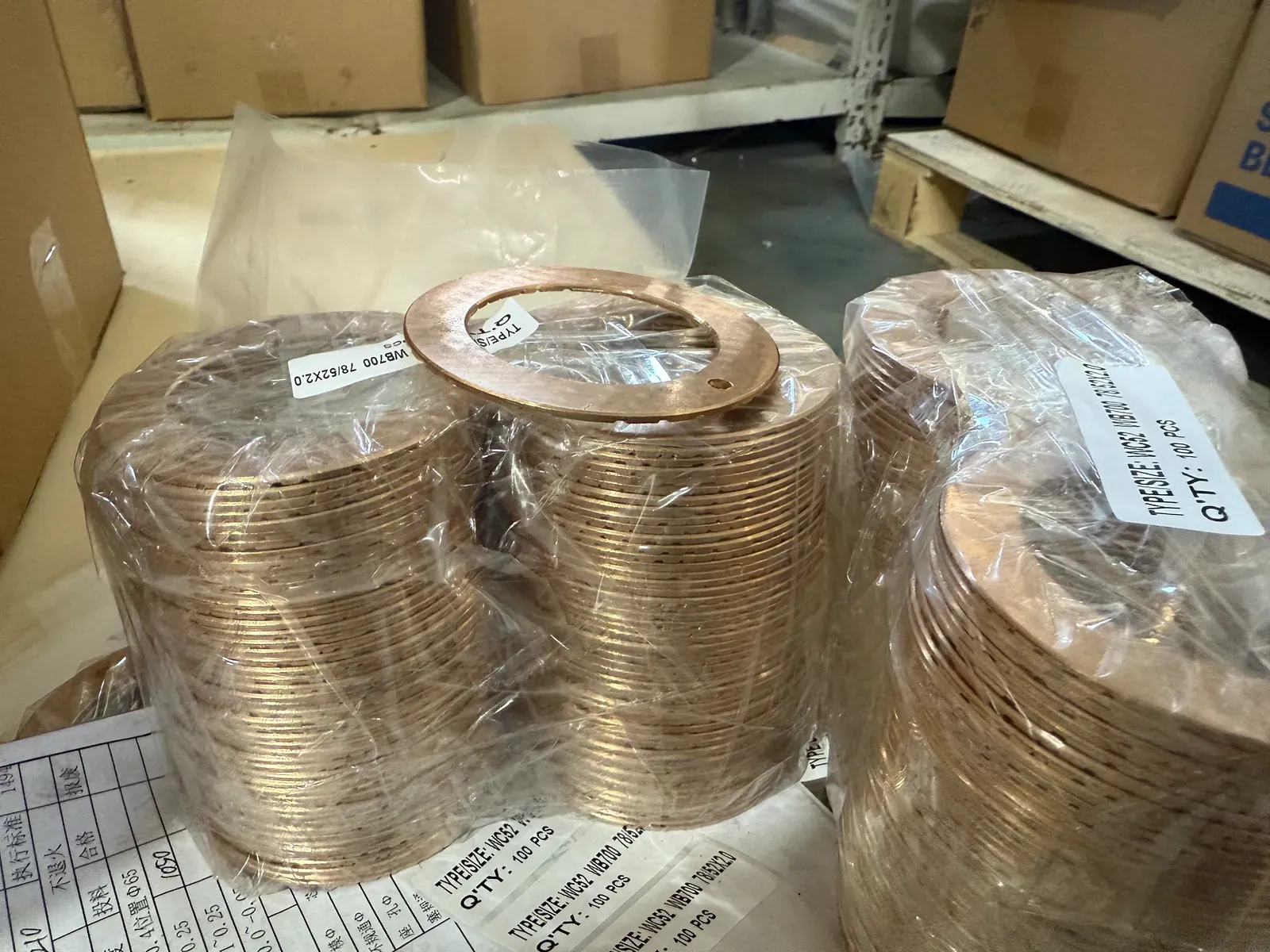
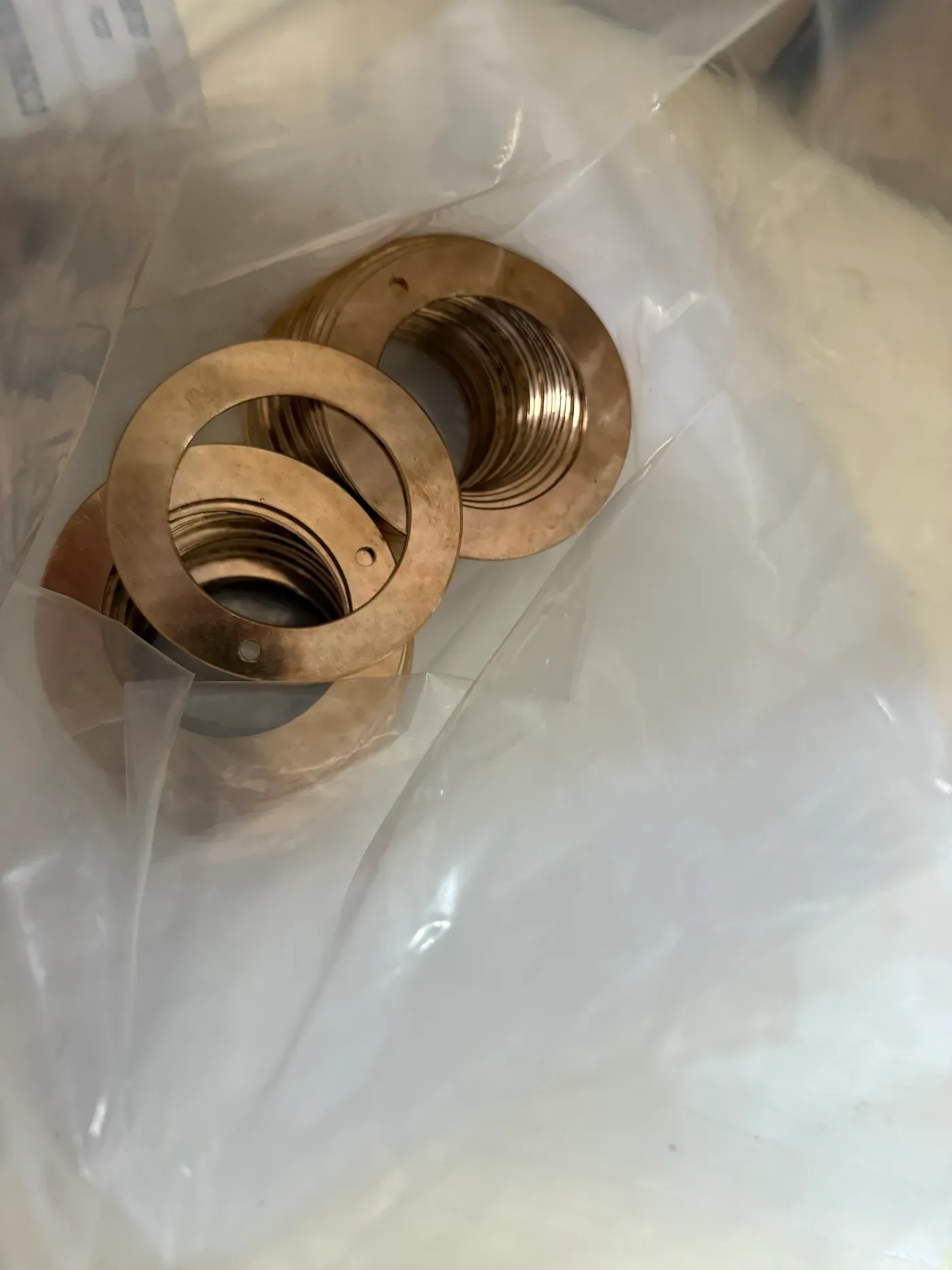
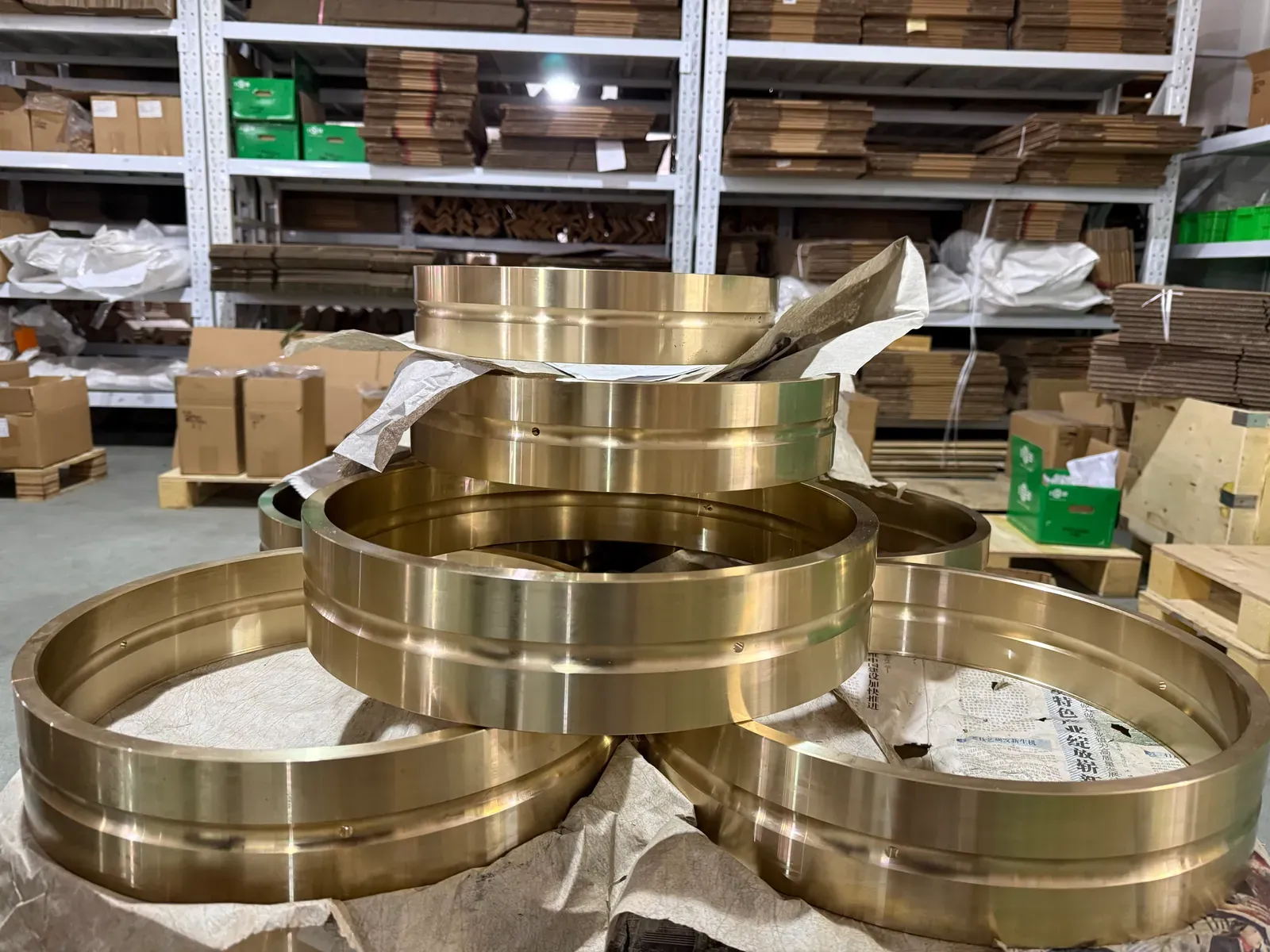
A thrust washer is a plain axial bearing: a ring with bore d slightly larger than the shaft, outside diameter D and thickness s, whose face slides against a rotating or oscillating collar on a grease film. It replaces a rolling thrust bearing where the speed is low, the load high or shock-like, and space or dirt rule out rollers.
- Bore = shaft + 0.5 mm (to Ø50) or + 1 mm (above), so the washer is located by the housing or a pin, not by the shaft
- Thickness 2 – 12 mm in the series; thicker washers and split (two-piece) washers to drawing
- Face options: plain (G1), two to six radial grooves (G7), or grease pockets (G8)
- Location against rotation: counterbore in the housing, a dowel pin in a hole, or a tab on the outer edge – specify one
- Load: 25 N/mm² moving, 45 N/mm² stationary on the net face area (ring minus grooves), greased
Thrust washer size chart (mm)
Slidura series ordered by shaft size: 660W-25 is a C93200 washer for a Ø25 shaft – bore 25.5, outside Ø42, 3 mm thick. ISO 4379 has no thrust washers, so this table is our proposal, proportioned like the washers used with the ISO sleeve series; it is under confirmation and every other d × D × s is made to drawing at the same price band.
All dimensions in mm
Type a bore to show only that row; click a length to ask for a quote on that order code.
| Shaft | Bore d | Outside Ø D | Thickness s | Weight (kg) | Order code |
|---|---|---|---|---|---|
| 12 | 12.5 | 24 | 2 (0 / −0.1) | 0.006 | 660W-12 |
| 15 | 15.5 | 28 | 2 (0 / −0.1) | 0.008 | 660W-15 |
| 16 | 16.5 | 30 | 2 (0 / −0.1) | 0.009 | 660W-16 |
| 18 | 18.5 | 32 | 2.5 (0 / −0.1) | 0.012 | 660W-18 |
| 20 | 20.5 | 36 | 2.5 (0 / −0.1) | 0.015 | 660W-20 |
| 22 | 22.5 | 38 | 2.5 (0 / −0.1) | 0.016 | 660W-22 |
| 25 | 25.5 | 42 | 3 (0 / −0.1) | 0.023 | 660W-25 |
| 28 | 28.5 | 48 | 3 (0 / −0.1) | 0.031 | 660W-28 |
| 30 | 30.5 | 50 | 3 (0 / −0.1) | 0.033 | 660W-30 |
| 32 | 32.5 | 54 | 3 (0 / −0.1) | 0.039 | 660W-32 |
| 35 | 35.5 | 58 | 3 (0 / −0.1) | 0.044 | 660W-35 |
| 40 | 40.5 | 62 | 4 (0 / −0.1) | 0.062 | 660W-40 |
| 45 | 45.5 | 70 | 4 (0 / −0.1) | 0.079 | 660W-45 |
| 50 | 50.5 | 78 | 4 (0 / −0.1) | 0.099 | 660W-50 |
| 55 | 56 | 82 | 5 (0 / −0.1) | 0.13 | 660W-55 |
| 60 | 61 | 90 | 5 (0 / −0.1) | 0.15 | 660W-60 |
| 65 | 66 | 95 | 5 (0 / −0.1) | 0.16 | 660W-65 |
| 70 | 71 | 100 | 5 (0 / −0.1) | 0.17 | 660W-70 |
| 75 | 76 | 110 | 6 (0 / −0.1) | 0.27 | 660W-75 |
| 80 | 81 | 115 | 6 (0 / −0.1) | 0.28 | 660W-80 |
| 90 | 91 | 130 | 6 (0 / −0.1) | 0.36 | 660W-90 |
| 100 | 101 | 140 | 8 (0 / −0.1) | 0.53 | 660W-100 |
| 110 | 111 | 160 | 8 (0 / −0.1) | 0.75 | 660W-110 |
| 120 | 121 | 170 | 8 (0 / −0.1) | 0.80 | 660W-120 |
| 140 | 141 | 200 | 10 (0 / −0.1) | 1.4 | 660W-140 |
| 160 | 161 | 220 | 10 (0 / −0.1) | 1.6 | 660W-160 |
| 180 | 181 | 250 | 10 (0 / −0.1) | 2.1 | 660W-180 |
| 200 | 201 | 280 | 12 (0 / −0.1) | 3.2 | 660W-200 |
No ISO 4379 size with this bore – send us the dimensions, we machine it to drawing.
Proposed Slidura series – ISO 4379 has no thrust washers. Any other d, D or s is machined to drawing.
Weight per piece in kg, plain part in C93200 (8.93 g/cm³); aluminium bronze is about 16 % lighter, SAE 67 about 4 % heavier.
Thickness tolerance 0 / −0.1 mm, faces parallel within 0.05 mm, Ra 1.6 µm. Grooved faces (G7) and other alloys: state in the enquiry.
Face load, speed and grooves
Specific face load p = F / A with A = π/4 × (D² − d²) minus the groove area. Sliding speed is taken at the mean diameter, v = π × (D + d)/2 × n. Both are compared with the general limits for greased cast bronze below.
| Parameter | Typical | Unit |
|---|---|---|
| Specific load p, moving | 25 | N/mm² |
| Specific load p, stationary | 45 | N/mm² |
| Sliding speed v | 0.5 | m/s |
| Coefficient of friction | 0.08 – 0.15 | µ |
| Working temperature | −40 … +250 | °C |
| Housing | H7 | ISO 286 |
| Shaft | e7–e8 | ISO 286 |
| Condition | grease or oil, boundary lubrication, steel shaft | |
Washers run hotter than bushes because the face has no housing to conduct heat into; above about 0.3 m/s at full load use grooved faces and oil rather than grease.
Grooves on the face and how the washer is located
A plain face works for slow oscillation under moderate load – the grease put on at assembly stays. On a continuously rotating collar the face must be fed: two to six straight radial grooves (G7), 1 – 3 mm wide and about a third of the thickness deep, stopped 2 mm short of the outer edge, let grease from the bore reach the whole face and give wear debris somewhere to go. Grease pockets (G8) suit slow, heavily loaded, rarely relubricated positions such as crane slewing rings.
Rotation must be prevented on the static side, otherwise the washer spins and wears the housing: a counterbore that holds the outer diameter, a dowel pin in a hole in the washer, or a tab on the outer edge that drops into a slot. Tell us which and we machine the hole, tab or the counterbore-fit outside diameter (h9).
For your enquiry:Send axial load, rpm or oscillation, collar hardness and how the washer is held – we size the face and grooves.
Which material for a thrust washer
C93200 / SAE 660 for general duty against a steel collar of at least 200 HB. C86300 or aluminium bronze C95400 / C95500 when the thrust is shock-like (crusher and press linkages, slewing) – they need a hardened collar of 300 HB or more. LG2 / C83600 in water and pumps at light load, tin bronze CuSn12 for lead-free positions and higher face pressure with a hard collar.
Steel washers gall on steel; PTFE-lined composite washers are thinner and run dry but are limited to about 2 N/mm² moving and cannot be re-machined – they belong to our metal-polymer range, compared on the types page.
Bronze thrust washer or rolling thrust bearing?
The two solve the same axial load with different weaknesses:
| Criterion | Cast bronze washer | Rolling thrust bearing |
|---|---|---|
| Speed | to about 0.5 m/s greased | high – thousands of rpm |
| Load character | shock, edge loading, misalignment tolerated | brinells under shock and misalignment |
| Axial space | 2 – 12 mm | 10 – 40 mm |
| Dirt, water, sand | embeds dirt, corrosion resistant | seals needed, fails on contamination |
| Friction | 0.08 – 0.15 greased | 0.002 – 0.005 |
| Cost and replacement | cheap, re-machinable, any size | standard sizes only above Ø200 expensive |
Conclusion: slow, heavily loaded, dirty or oscillating – bronze washer; fast continuous rotation with clean lubrication – rolling bearing.
Thrust washer or flanged bushing?
A flanged bushing combines radial bush and thrust face in one part and is the neater solution up to about Ø120 mm. A separate washer is chosen when thrust acts in both directions, when the face wears faster than the bore and should be replaceable alone, and above Ø120 mm where a flange would need a far larger bar. The flanged page has the full comparison.
How to order a thrust washer
Order by shaft size from the table, or send d × D × s. Add axial load and speed so we can check the face and propose grooves.
Example
660W-25C93200 thrust washer for a Ø25 shaft: bore 25.5 × outside Ø42 × 3 mm thick, plain face.
- Order code, or d × D × s (mm or inch)
- Alloy – C93200 unless stated
- Axial load, rotating or oscillating, rpm
- Face: plain, G7 radial grooves (how many) or G8 pockets
- Location: counterbore, dowel hole (Ø and position) or tab
- Quantity and delivery country
Where bronze thrust washers are used
Between a collar and a housing wherever a rolling thrust bearing is too big, too fast or too fragile:
- Construction and mining machinerySlewing and boom pivots, crusher eccentric thrust faces, track roller ends
- Agricultural machinerySteering axle kingpins, header and reel pivots, gearbox end faces
- Pumps, valves and hydraulicsPump shaft end faces, gear pump thrust plates, valve stem thrust
- Steel mills, sugar mills, heavy industryRoller table and mill shaft end thrust, large slewing rings in segments
Frequently asked questions
What are bronze thrust washers used for?
To take the axial load of a shaft at low speed: excavator slewing and boom pivots, gearbox and pump shaft end faces, agricultural kingpins and pivots, mill and roller shaft ends. They replace rolling thrust bearings where shock, dirt, low speed or space make rollers a bad choice, and steel-on-steel faces that would gall.
Do thrust washers need grooves?
On a rotating collar under more than light load, yes – radial grooves carry grease from the bore across the face and give debris an exit. On a slow oscillating pivot, a plain face greased at assembly and relubricated through the bush is enough. We cut two to six grooves (G7) or pockets (G8) on request.
Can you make thrust washers over Ø300 mm?
Yes, to Ø1000 mm outside diameter in one piece from cast ring or plate, or in two or more segments for very large slewing faces. Send d × D × s, the axial load and the bolt or dowel pattern.
Brass or bronze washer?
Bronze against a steel collar. Ordinary brass galls; the high-strength brass C86300 is the exception and is used for shock thrust with a hardened collar. The bronze-vs-brass page explains the difference.
Do you supply oil-impregnated (Oilite type) washers?
No – this range is solid cast bronze, which carries five to ten times the face load of a sintered washer but needs external grease. Sintered, wrapped, bimetal, graphite-plugged and metal-polymer washers are compared on the types page.
Send axial load and rpm
We size the washer, propose the groove pattern and quote – standard series or to drawing, no minimum quantity.