
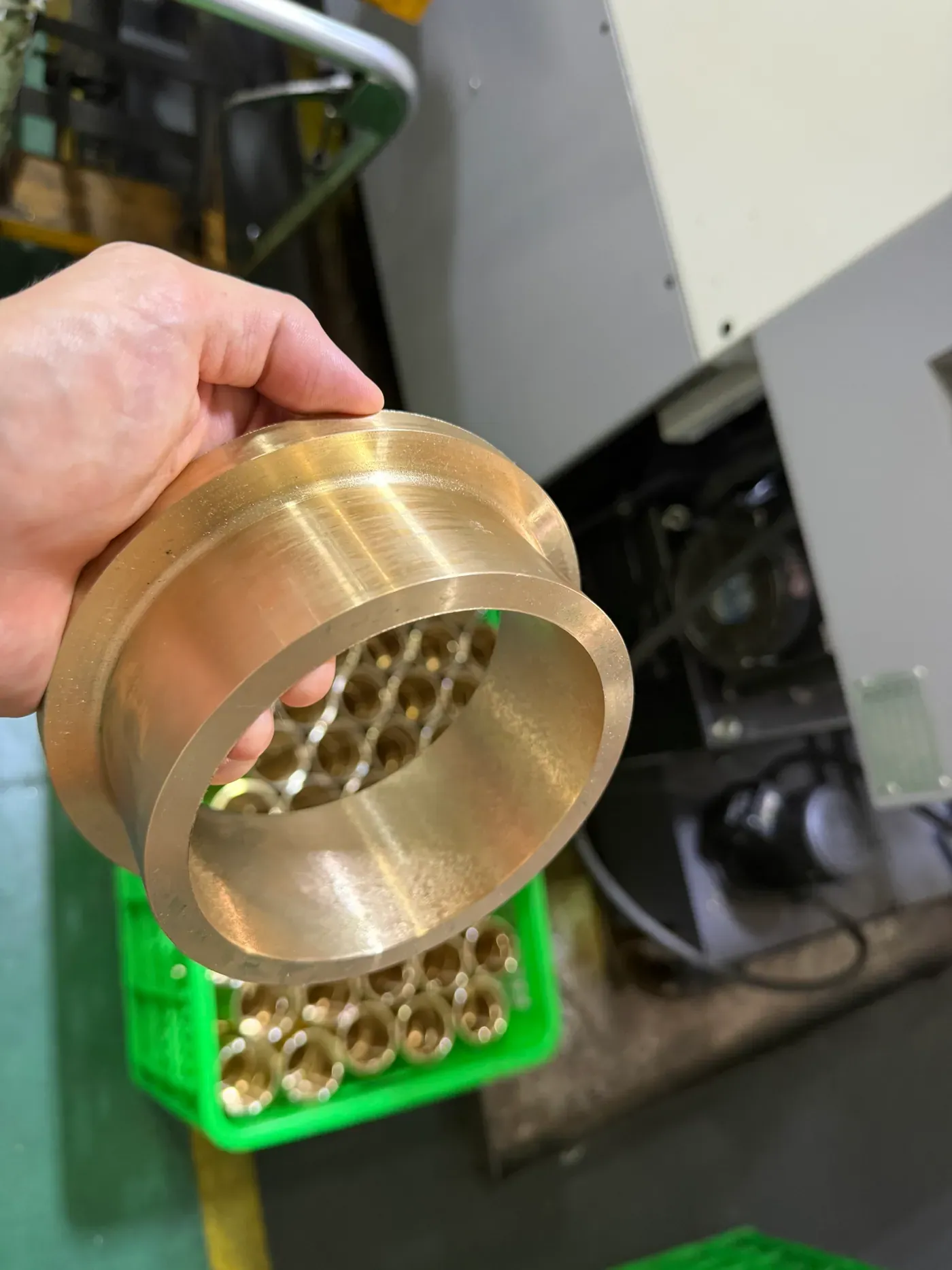
C86300 / SAE 430B manganese bronze bushings
Called manganese bronze, C86300 is a high-strength brass: 63 % copper, 25 % zinc, hardened by 6 % aluminium, 3 % manganese and 3 % iron to 758 N/mm² (110 ksi) minimum tensile and 225 HB. Bushings in this alloy carry extreme static and shock loads at very low speed – excavator and crane pins, slewing bushes, press and crusher linkages – where tin bronze deforms. They need a hardened shaft, clean lubricant and protection from warm saline water.
C86300 (UNS) / SAE 430B / CDA 863 is cast to ASTM B505 (continuous) and B271 (centrifugal) and machined into bushings, washers and wear parts. The European equivalent is CuZn25Al5Mn4Fe3-C, EN 1982 CC762S; the Chinese grade ZCuZn25Al6Fe3Mn3. The CuZn25Al5Mn4 base alloy of graphite-plugged bushings is the same class.
- Composition (ASTM B505): Cu 60 – 66, Zn 22 – 28, Al 5.0 – 7.5, Mn 2.5 – 5.0, Fe 2.0 – 4.0, Pb ≤ 0.20 %
- Minimums: tensile 758 N/mm² (110 ksi), yield 427 N/mm² (62 ksi), elongation 14 %; 225 HB typical (3000 kg); compressive strength 0.1 % set 345 N/mm²
- Density 7.8 g/cm³, E 105 GPa, expansion 21.2 × 10⁻⁶ /K, machinability 8 (slow, carbide tooling)
- Not heat-treatable; about 200 °C continuous, strength declines above ~260 °C
- Dezincification risk in warm saline water – not for seawater; lead ≤ 0.2 % (lead-free by RoHS)
Chemical composition
C86300 / SAE 430B · CuZn25Al5Mn4Fe3
| Element | Range (% by mass) | Nominal (%) |
|---|---|---|
| Cu | 60.0–66.0 | 63 |
| Zn | 22.0–28.0 | 25 |
| Al | 5.0–7.5 | 6 |
| Mn | 2.5–5.0 | 3 |
| Fe | 2.0–4.0 | 3 |
| Pb | ≤ 0.20 | — |
Composition and minimum properties per ASTM B505; typical values as cast.
Tensile strength · Hardness · Density
| Grade | Alloy | Family | Tensile strength standard minimum (MPa) | Yield strength (0.5 % ext. / Rp0.2) standard minimum (MPa) | Elongation (%) | Hardness (HB) | Tensile strength typical (MPa) | Density (g/cm³) | Machinability (C36000 = 100) |
|---|---|---|---|---|---|---|---|---|---|
| C86300 / SAE 430B | CuZn25Al5Mn4Fe3 | high-strength brass (manganese bronze) | 758 | 427 | 14 | 225 typical (3000 kg) | 820 | 7.8 | 8 |
Composition and minimum properties per ASTM B505; typical values as cast.
Also known as
| Parameter | C86300 / SAE 430BCuZn25Al5Mn4Fe3 |
|---|---|
| UNS / ASTM | C86300 |
| SAE | SAE 430B |
| EN 1982 | CuZn25Al5Mn4Fe3-C · CC762S |
| DIN (old) | G-CuZn25Al5 · 2.0598 |
| BS 1400 | HTB3 |
| JIS H5120 | CAC304 (HBsC4) |
| GB/T 1176 | ZCuZn25Al6Fe3Mn3 |
| ГОСТ 613 | ЛЦ23А6Ж3Мц2 |
| PN (Poland) | MA58 (verify) |
| Also known as | CDA 863 · "manganese bronze" · high-tensile brass · same class as CuZn25Al5Mn4 (graphite-plugged 650 base alloy) · AMS 4862 |
Composition and minimum properties per ASTM B505; typical values as cast.
When to use C86300 – and what it demands in return
The alloy for positions where the specific load is at or above the limit of tin bronze and the movement is slow or intermittent: bucket and boom pins on large excavators, crane and slewing bushes, press linkage pins, crusher toggle and eccentric bushes, heavy gate bushes, thrust washers under shock. Its 427 N/mm² yield strength means the bush does not flow or brinell under impact the way a 65 HB tin bronze does, and its 225 HB gives the longest life against abrasive wear when the grease is clean.
It demands: a hardened shaft – 300 HB minimum, ground – because the bush is as hard as an unhardened shaft and would wear it; clean lubricant, since it does not embed grit; a generous running clearance (e8 rather than e7) because it does not conform; and a medium without warm saline or acidic water, in which the high-zinc alloy dezincifies. It machines slowly (rating 8) with carbide tooling, so it costs about twice a 660 bush and is not re-bored in the field as easily.
| Criterion | C86300 | Aluminium bronze C95400 | C93200 / SAE 660 |
|---|---|---|---|
| Min. tensile / yield, N/mm² | 758 / 427 | 586 / 221 | 207 / 110 |
| Hardness HB | 225 | 170 | 65 – 75 |
| Load | extreme | high | medium |
| Speed | very low, oscillating | low – medium | to 0.5 m/s |
| Shock | excellent | very good | moderate |
| Corrosion | not in warm saline (dezincification) | seawater good | fresh water |
| Temperature | ≈ 200 °C continuous | 250 °C | 250 °C |
| Shaft | hardened 300 HB+, ground | hardened 300 HB+ | plain steel |
| Machinability | 8 | 60 | 70 |
For your enquiry:For C86300: load or force and pin diameter, shaft hardness, movement and how the position is greased.
"Manganese bronze", high-tensile brass, QMn – names that confuse
The trade name manganese bronze comes from the 3 % manganese; metallurgically C86300 is a brass (copper-zinc alloy) and appears in the brass sections of the standards – C86xxx in UNS, CC762S in EN 1982, HTB3 in BS 1400, CAC304 (HBsC4) in JIS, ЛЦ23А6Ж3Мц2 in ГОСТ. It is not related to the wrought manganese bronzes QMn1.5 / QMn5 of Chinese and Russian practice, which are copper-manganese alloys for springs and electrical parts, nor to the manganese-aluminium bronze CuMn11Al8Fe3Ni3 (C95700) of marine propellers.
| System | Designation |
|---|---|
| UNS / CDA | C86300 · CDA 863 |
| SAE | SAE 430B (also SAE J462 CA863) |
| ASTM | B505 (continuous cast), B271 (centrifugal), B147 alloy 8C, B22 (bridge bearing plates), B584 |
| EN 1982 | CuZn25Al5Mn4Fe3-C · CC762S |
| DIN (old) | G-CuZn25Al5 · 2.0598 |
| BS 1400 | HTB3 |
| JIS H5120 | CAC304 (HBsC4) |
| GB/T 1176 | ZCuZn25Al6Fe3Mn3 |
| ГОСТ 17711 | ЛЦ23А6Ж3Мц2 |
| Other | AMS 4862 · QQ-C-390 86300 · MIL-C-15345 alloy 6 · MIL-C-22229 comp. 8 · ingot 424 |
Design notes for C86300 bushings
Wall thickness can be thinner than for tin bronze at the same load thanks to the yield strength, but keep the ISO 4379 walls for the press fit – a thin hard bush cracks when pressed into an out-of-round housing. Chamfer the housing, press with a mandrel or shrink-fit; check the bore after fitting because the alloy closes less than tin bronze (higher modulus, 105 GPa).
Running clearance: e8 shaft or 0.15 – 0.25 % of the diameter, more for hot positions (expansion 21.2 × 10⁻⁶ /K, higher than steel). Grease: EP grease with solid additives (MoS₂ or graphite) for slow heavy pins, fed through a G3 circumferential groove under the nipple for oscillating pins or G4 figure-8 for rotation. Never run dry – there is no lead to save the surface.
Where C86300 bushings are used
Extreme load at low speed:
- Large excavators, loaders and cranes: boom, stick, bucket and slewing pins Ø80 – 300 mm
- Presses and forging: ram guides, linkage and eccentric bushes
- Crushers and screens: toggle seats, eccentric and pitman bushes
- Hydraulic cylinders under shock: rod-eye and gland bushes
- Bridge and structural bearings (ASTM B22 plates), heavy gate pivots
- Thrust washers and wear plates under impact
Forms and sizes in C86300
All ISO 4379 sleeve and flanged sizes, thrust washers, and parts to drawing to Ø1000 mm from centrifugally cast tube. Stock is bought per order; allow for the slower machining in the lead time we quote.
Frequently asked questions
Is C86300 a bronze or a brass?
A brass by chemistry – 60 – 66 % copper and 22 – 28 % zinc – sold as "manganese bronze" for historical reasons. It sits in the brass sections of UNS (C86xxx), EN 1982 (CC762S) and BS 1400 (HTB3). As a bearing material it behaves like a very hard bronze.
How strong is C86300 compared with SAE 660?
Minimum tensile 758 against 207 N/mm², yield 427 against 110 N/mm², hardness 225 against 65 – 75 HB – roughly three to four times. The price of that strength is a hardened shaft, clean grease and slow machining.
Can C86300 run in seawater?
Not recommended. High-zinc brasses dezincify in warm saline or acidic water and lose strength. For seawater use nickel-aluminium bronze C95500; for fresh water C86300 is fine.
What shaft does C86300 need?
Hardened and ground steel of at least 300 HB, typically 45 – 55 HRC, Ra 0.8 µm or better. On an unhardened shaft the bush wins and the shaft wears.
Is CuZn25Al5Mn4 the same as C86300?
Same alloy class – CuZn25Al5Mn4Fe3-C (CC762S) is the EN designation and CuZn25Al5Mn4 the short name used for the base alloy of graphite-plugged bushings. Composition ranges overlap; C86300 to ASTM B505 is what we machine for solid bushings.
Quote C86300 bushings
Send sizes or drawing, the load and pin diameter, shaft hardness and lubrication – we confirm the alloy suits and quote.