
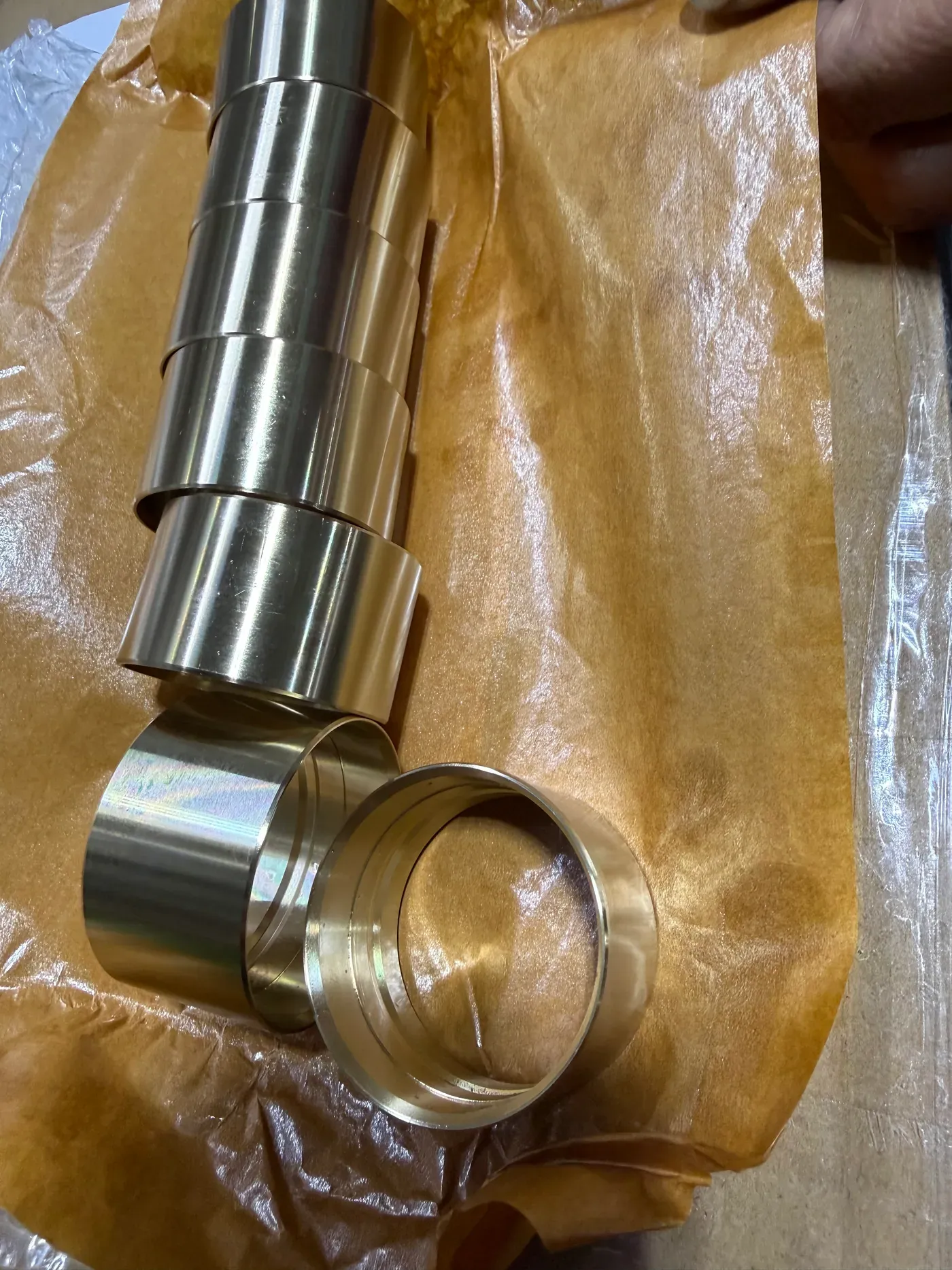
Aluminium bronze bushings – C95400, C95500, CuAl10Fe3Mn2
Copper-aluminium-iron alloys with two to three times the strength of SAE 660: 586 N/mm² minimum tensile and 170 HB for C95400, 655 N/mm² and 195 HB for the nickel grade C95500. They resist shock, cavitation, erosion and seawater and keep their strength above 200 °C – in return they need a hardened shaft and continuous lubrication. Machined into sleeve, flanged and thrust parts from Ø6 to Ø1000 mm.
Aluminium bronze is a copper alloy hardened by 9 – 11.5 % aluminium with iron and, in C95500, nickel. In bushings it is chosen when the load or the medium is beyond a tin bronze: pins under extreme edge loading, marine and hydro equipment, hot positions, pumps handling seawater or slurry.
- C95400 – CuAl10Fe3 (GB ZCuAl10Fe3, DIN 2.0940, BS AB1, JIS CAC702): 586 N/mm² min., 170 HB typical, density 7.45 g/cm³
- C95500 – CuAl10Ni5Fe4 (EN CC333G CuAl10Fe5Ni5-C, DIN 2.0975, BS AB2, JIS CAC703, ГОСТ БрА10Ж4Н4Л): 655 N/mm² min., 195 HB, best seawater resistance
- CuAl10Fe3Mn2 (GB ZCuAl10Fe3Mn2, PN BA1032, ГОСТ БрА10Ж3Мц2): 490 N/mm² min., 110 HB min. – the grade Polish and CIS drawings name
- Shaft: hardened 300 HB minimum, typically 45 – 55 HRC, Ra ≤ 0.8 µm; a soft shaft is worn by the bush
- Lead-free by composition; no dezincification; usable to about 250 °C, C95500 higher
Chemical composition
C95400 · CuAl10Fe3
| Element | Range (% by mass) | Nominal (%) |
|---|---|---|
| Cu | ≥ 83.0 (balance) | 85 |
| Al | 10.0–11.5 | 11 |
| Fe | 3.0–5.0 | 4 |
| Ni | ≤ 1.5 | — |
| Mn | ≤ 0.5 | — |
* Typical values per ASTM B505 / B271, EN 1982 and GB/T 1176 for the cast alloy; not a guarantee for a specific part. Test certificates (chemical analysis, hardness) are supplied on request with the order.
C95500 · CuAl10Ni5Fe4
| Element | Range (% by mass) | Nominal (%) |
|---|---|---|
| Cu | ≥ 78.0 (balance) | 81 |
| Al | 10.0–11.5 | 11 |
| Ni | 3.0–5.5 | 4 |
| Fe | 3.0–5.0 | 4 |
| Mn | ≤ 3.5 | — |
* Typical values per ASTM B505 / B271, EN 1982 and GB/T 1176 for the cast alloy; not a guarantee for a specific part. Test certificates (chemical analysis, hardness) are supplied on request with the order.
CuAl10Fe3Mn2 (ZCuAl10Fe3Mn2) · CuAl10Fe3Mn2
| Element | Range (% by mass) | Nominal (%) |
|---|---|---|
| Cu | balance | 85 |
| Al | 9.0–11.0 | 10 |
| Fe | 2.0–4.0 | 3 |
| Mn | 1.0–2.0 | 1.5 |
| Ni | ≤ 0.5 | — |
| Zn | ≤ 0.5 | — |
* Typical values per ASTM B505 / B271, EN 1982 and GB/T 1176 for the cast alloy; not a guarantee for a specific part. Test certificates (chemical analysis, hardness) are supplied on request with the order.
Tensile strength · Hardness · Density
| Grade | Alloy | Family | Tensile strength standard minimum (MPa) | Yield strength (0.5 % ext. / Rp0.2) standard minimum (MPa) | Elongation (%) | Hardness (HB) | Tensile strength typical (MPa) | Density (g/cm³) | Machinability (C36000 = 100) |
|---|---|---|---|---|---|---|---|---|---|
| C95400* | CuAl10Fe3 | aluminium bronze | 586 | 221 | 12 | ≥ 150 (170 typical) | 620 | 7.45 | 60 |
| C95500* | CuAl10Ni5Fe4 | aluminium bronze | 655 | 290 | 10 | ≥ 190 (195 typical) | 690 | 7.53 | 50 |
| CuAl10Fe3Mn2 (ZCuAl10Fe3Mn2)* | CuAl10Fe3Mn2 | aluminium bronze | 490 | — | 15 | ≥ 110 | — | 7.5 | — |
* Typical values per ASTM B505 / B271, EN 1982 and GB/T 1176 for the cast alloy; not a guarantee for a specific part. Test certificates (chemical analysis, hardness) are supplied on request with the order.
Also known as
| Parameter | C95400CuAl10Fe3 | C95500CuAl10Ni5Fe4 | CuAl10Fe3Mn2 (ZCuAl10Fe3Mn2)CuAl10Fe3Mn2 |
|---|---|---|---|
| UNS / ASTM | C95400 | C95500 | C95400 (nearest) |
| SAE | — | — | — |
| EN 1982 | CuAl10Fe2-C · CC331G (nearest) | CuAl10Fe5Ni5-C · CC333G | CuAl10Fe2-C · CC331G (nearest) |
| DIN (old) | G-CuAl10Fe · 2.0940 | G-CuAl10Ni · 2.0975 | G-CuAl10Fe · 2.0940 (nearest) |
| BS 1400 | AB1 | AB2 | AB1 (nearest) |
| JIS H5120 | CAC702 (AlBC2) | CAC703 (AlBC3) | CAC702 (nearest) |
| GB/T 1176 | ZCuAl10Fe3 | ZCuAl10Fe4Ni4 (nearest) | ZCuAl10Fe3Mn2 |
| ГОСТ 613 | БрА10Ж3Мц2 (nearest) · БрА9Ж3Л | БрА10Ж4Н4Л | БрА10Ж3Мц2 |
| PN (Poland) | BA1032 (nearest) | BA1044 (verify) | BA1032 |
| Also known as | CDA 954 · aluminium bronze 9C · UA10N (FR) is the nickel grade, not this one | CDA 955 · nickel-aluminium bronze · UA10N (FR) · same class as CuAl10Ni5Fe5 (graphite-plugged 650S2 base alloy) | Manganese-bearing variant of CuAl10Fe3; Polish BA1032 and Russian БрА10Ж3Мц2 buyers know it by name |
* Typical values per ASTM B505 / B271, EN 1982 and GB/T 1176 for the cast alloy; not a guarantee for a specific part. Test certificates (chemical analysis, hardness) are supplied on request with the order.
When aluminium bronze beats tin bronze – and when it does not
Choose it when a C93200 bush deforms or wears out early under shock or edge loading, when the medium is seawater, brackish or process water that attacks tin bronze and steel-backed bushings, when the position runs above 150 °C, or when cavitation and erosion (pump wear rings, gate bushes) eat softer alloys.
Stay with tin bronze when the shaft is unhardened, when lubrication is occasional (aluminium bronze has no lead to smear and seizes when dry), when dirt cannot be kept out (it does not embed grit) and when the position is a cheap, easily replaced pin. C95400 vs C93200 in numbers: 586 vs 207 N/mm² tensile, 170 vs 70 HB, 7.45 vs 8.93 g/cm³, machinability 60 vs 70 – and a hardened shaft instead of plain steel.
| Property | C95400 | C95500 | CuAl10Fe3Mn2 | C93200 (reference) |
|---|---|---|---|---|
| Min. tensile, N/mm² | 586 | 655 | 490 | 207 |
| Min. yield, N/mm² | 221 | 290 | — | 110 |
| Hardness HB | 150 min. / 170 typ. | 190 min. / 195 typ. | 110 min. | 65 – 75 |
| Density, g/cm³ | 7.45 | 7.53 | 7.5 | 8.93 |
| Seawater | good | excellent | good | poor |
| Shock | very good | excellent | very good | moderate |
| Shaft | hardened 300 HB+ | hardened 300 HB+ | hardened 300 HB+ | plain steel |
| Machinability | 60 | 50 | ≈ 60 | 70 |
For your enquiry:Give the shaft material and hardness with the enquiry – it decides whether aluminium bronze is safe in your position.
C95400, C95500 or CuAl10Fe3Mn2
C95400 is the general aluminium bronze: strong, tough, castable, the default for heavy pins, gears and pump parts in fresh water. C95500 adds 4 – 5 % nickel for higher strength, better seawater and erosion resistance and less loss of strength when hot – marine, offshore and hydro positions, and wherever the drawing names CuAl10Ni5Fe4 / AB2 / CAC703. CuAl10Fe3Mn2 is the Chinese and Eastern European standard grade (ZCuAl10Fe3Mn2, BA1032, БрА10Ж3Мц2), slightly lower in minimum strength on paper because GB/T 1176 tests differently, and interchangeable with C95400 in service; we machine it when the drawing calls for it.
All three are cast continuously or centrifugally to ASTM B505 / B271, EN 1982 or GB/T 1176 and bought per order – aluminium bronze tube is less readily available than C93200, so standard sizes take longer than 660 and are quoted with the date.
Fitting and running aluminium bronze bushings
Same fits as tin bronze – housing H7, bush s6 / r6, bore E6 closing to about H8 – but the higher modulus (about 110 GPa against 100) and lower ductility mean the bore closes a little less and the bush does not forgive an oval or oversize housing. Press with a mandrel or shrink in; do not hammer. Shaft hardened and ground to Ra 0.8 µm or better, hard chrome where the medium is corrosive; grease with an EP grease or oil continuously – aluminium bronze cannot run dry even briefly.
Running clearance the same as tin bronze at room temperature; add clearance for hot positions using the 17 × 10⁻⁶ /K expansion of the alloy against the housing material.
Designations of the three aluminium bronzes
| System | C95400 | C95500 | CuAl10Fe3Mn2 |
|---|---|---|---|
| UNS / ASTM | C95400 (B505, B271, B148) | C95500 (B505, B271, B148) | — (nearest C95400) |
| EN 1982 | CuAl10Fe2-C CC331G (nearest) | CuAl10Fe5Ni5-C CC333G | CuAl10Fe2-C CC331G (nearest) |
| DIN (old) | G-CuAl10Fe 2.0940 | G-CuAl10Ni 2.0975 | G-CuAl10Fe 2.0940 (nearest) |
| BS 1400 | AB1 | AB2 | AB1 (nearest) |
| JIS H5120 | CAC702 (AlBC2) | CAC703 (AlBC3) | CAC702 (nearest) |
| GB/T 1176 | ZCuAl10Fe3 | ZCuAl10Fe4Ni4 (nearest) | ZCuAl10Fe3Mn2 |
| ГОСТ 493 | БрА9Ж3Л / БрА10Ж3Мц2 (nearest) | БрА10Ж4Н4Л | БрА10Ж3Мц2 |
| PN | BA1032 (nearest) | BA1044 (verify) | BA1032 |
Where aluminium bronze bushings are used
Positions where load, medium or temperature exceed what tin bronze takes:
- Marine and offshore: rudder and stabiliser bushes, deck machinery, seawater pump bushes and wear rings
- Hydropower and water control: gate and wicket-gate bushes, trash-rack and screen pivots
- Mining and quarrying: crusher and screen pivots, heavy pins in edge-loaded linkages
- Steel and rolling mills: hot-area bushes, descaler and coiler bushes to 250 °C
- Pumps and valves: slurry and seawater pumps, valve stem and gate bushes
- Presses and forging: ram guide bushes under shock
Forms and sizes in aluminium bronze
All ISO 4379 sleeve and flanged sizes and the thrust washer series, plus parts to drawing to Ø1000 mm from centrifugally cast tube. Stock is bought per order; the quotation states the lead time.
Frequently asked questions
Is aluminium bronze good for bushings?
Yes, for heavy load, shock, seawater and heat – it is two to three times as strong as SAE 660 and resists cavitation and erosion. It is not good for unhardened shafts, dry or occasional lubrication, or dirty positions: it has no lead to smear and does not embed grit.
C95400 vs C95500 – which one?
C95400 for heavy load in fresh water and general machinery; C95500 (nickel-aluminium bronze) for seawater, erosion, higher temperature and the highest load. C95500 costs more and machines slower. If the drawing says CuAl10Ni5Fe4, AB2, CAC703 or CC333G, it means C95500.
Does aluminium bronze need a hardened shaft?
Yes. At 170 – 195 HB the bush is harder than an unhardened steel shaft and would wear the shaft. Use a hardened and ground shaft of at least 300 HB (45 – 55 HRC typical), or hard chrome in corrosive media.
Is aluminium bronze lead-free?
Yes – C95400 and C95500 contain no intentional lead (ASTM limits residuals), so they meet RoHS, ELV and drinking-water lead limits. Check the whole material list for the application; nickel in C95500 may matter for food contact.
What is the difference between 932 and 954 bronze?
C93200 is a soft leaded tin bronze (207 N/mm², 65–75 HB) that forgives soft shafts and poor grease; C95400 is a hard aluminium bronze (586 N/mm², 170 HB) that takes shock, seawater and heat but needs a hardened shaft and continuous lubrication. Price about 1.5 times.
Quote aluminium bronze bushings
Send sizes or drawing, the shaft material and hardness, the medium and temperature – we confirm the grade and quote.